


What Painting Means : Jean-Marie Haessle
| [GALLERIES] Mizuma & Kips
Jean-Marie Haessle
What Painting Means: Jean-Marie Haessle is a retrospective exhibition of the French-American painter Jean-Marie Haessle (1939.09.12–2024.04.15), who was born in the mining village of Buhl in Alsace and worked as a miner from the age of fourteen before establishing his artistic career in New York’s Soho.
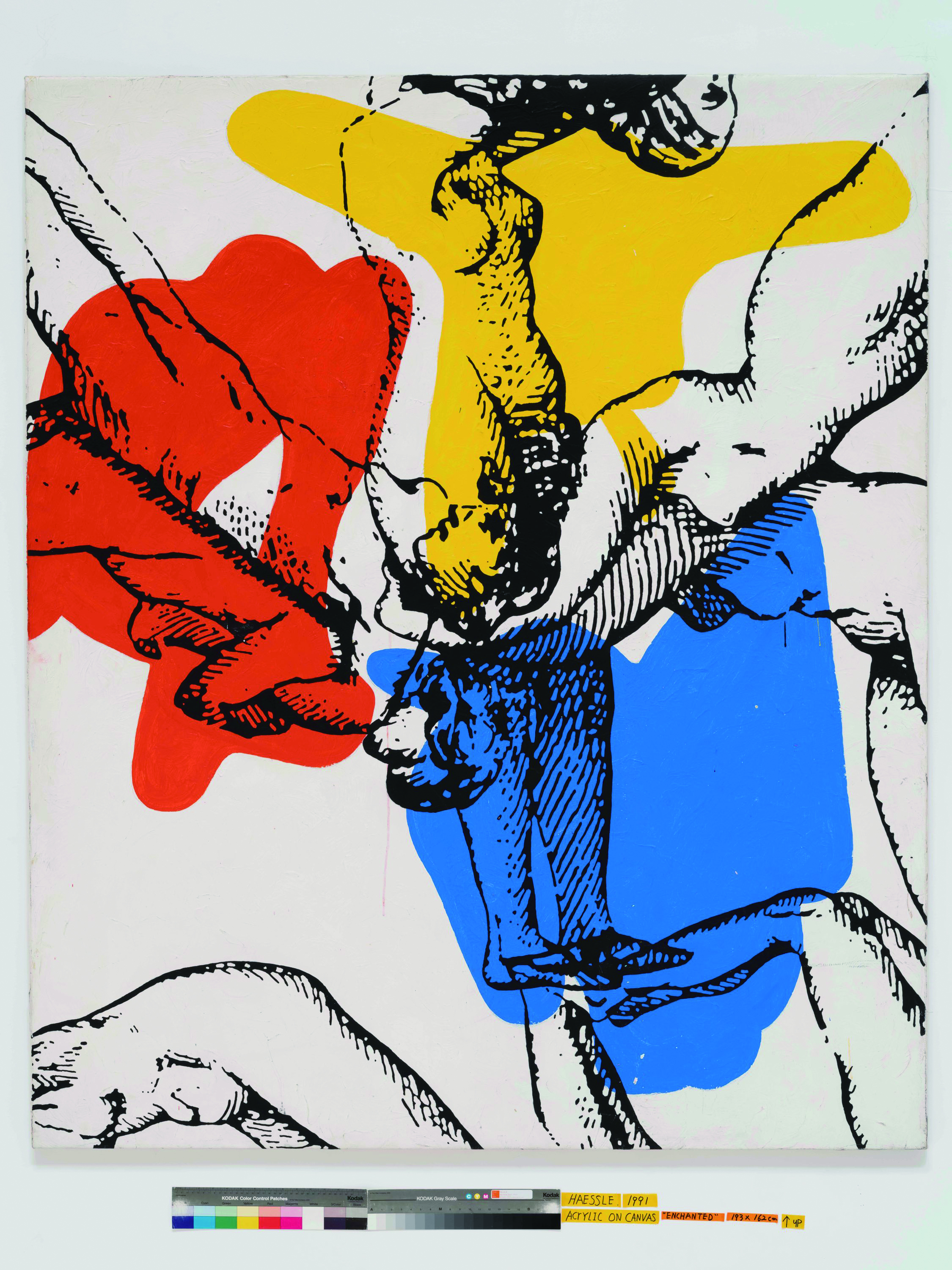
Enchanted, Acrylic on canvas, 193 x 162cm, 1991
Haessle’s aspiration to become a painter emerged while he was bedridden, recovering from an illness contracted in the mines. Reading La vie de Van Gogh (1957) captivated him, and he began copying van Gogh’s paintings, which became his first steps toward art. With no formal artistic training beyond copying masterpieces, the decisive turning point in his life came when he was reassigned from mining work to an apprenticeship in which he learned to design mining equipment. Using this technical skill as his foundation, he set out from home and arrived in Paris, where he encountered artists such as Jean Dubuffet (1901–1985), Alberto Giacometti (1901–1966), and members of the CoBrA group. Later, in New York’s Soho, he found himself among Louise Bourgeois (1911–2010), Andy Warhol (1928–1987), Donald Judd (1928–1994), Nam June Paik (1932–2006), Arman (1929–2005), Bernar Venet (1941– ), Ralph Gibson (1939– ), Ouattara Watts (1957– ), Lawrence Weiner (1942–2021), Budd Hopkins (1931–2011), and Jean-Michel Basquiat (1960–1988), fully embarking on the path of a painter.
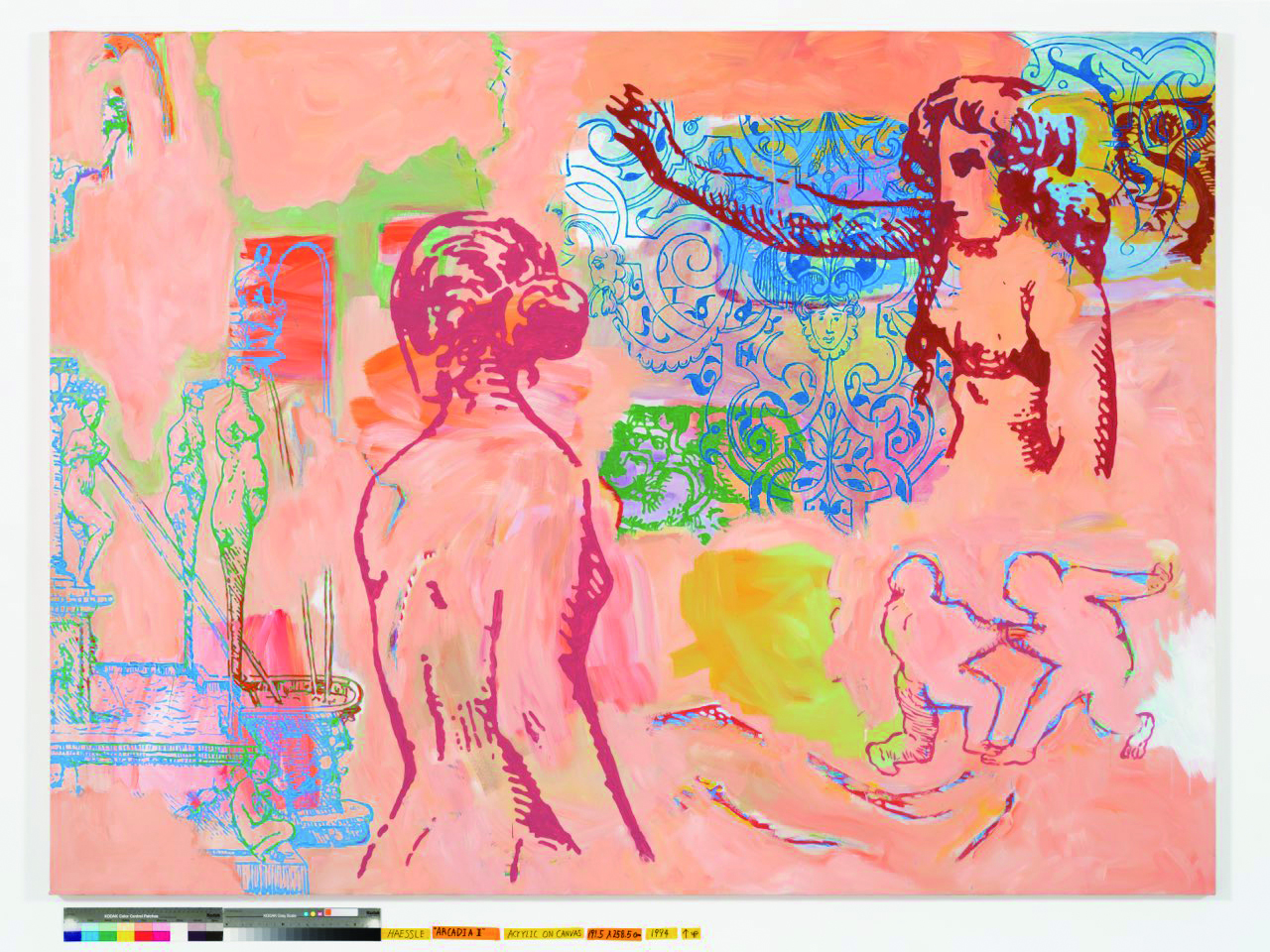
Arcadia I, Acrylic on canvas, 191.5 x 258.5cm, 1994
What Painting Means examines Haessle’s artistic achievements within the global art scene, focusing in particular on how he, as a self-taught painter, transcended the harsh realities of his life and circumstances—and what artistic realm he ultimately sought to reach.
The exhibition opens with Part I, From Life to Art, which explores how his life experiences propelled and shaped his artistic practice in reciprocal tension.
It then turns to the question of what constitutes true “Haessle-ness,” examining two themes that absorbed him throughout his life: the cosmos and nature, and the human figure.
Part II, Sidereus Nuncius, features the cosmic series Haessle developed in the 1980s after withdrawing from his earlier engagement with the issues dominating the New York art world—minimalism, conceptual art, installation art, and others. This section also includes the abstract yet lyrically charged landscape works from his later years.
Part III, Human, Again, presents the works of the 1990s, when Haessle, disillusioned with the intensely subjective works of the 1980s that he had believed to be the core of his artistic identity, sought equilibrium through renewed engagement with the human figure. This section culminates in his mature homages to artists such as Édouard Manet (1832–1883) and Erik Satie (1866–1925), revealing his deepened perspective on humanity in his later life.
Approaching an artist’s oeuvre through the lens of motifs may appear to be a modest task. Yet in front of Haessle’s works—which display such steep shifts in form, technique, and artistic intention that one might doubt they could come from a single painter—this approach offers a way to inch closer to the extraordinary, sensorial transparency that so powerfully infects viewers with artistic energy.
Perhaps for this reason, his whispered words linger in the ear:
“You see, painting—painting is what allowed me to live in this world at all.”
MIZUMA & KIPS
324 Grand Street, Ground Floor-B, New York
+1 646 284 5008
[GALLERIES] Mizuma & Kips
MORE LIKE THIS


