Displace
2026. 3. 18 – 4. 20 | [GALLERIES] SONG ART GALLERY
François Perrodin
Installation View (1)
François Perrodin’s recent series approaches displacement as a structural principle. Here, Displace refers to a condition in which the rectangle, as a minimal unit, shifts into different positions and circumstances. It is rearranged and, through this process, reconstitutes the order of relations. The artist organizes this procedure into rhythmic sequences, transforming the object into an apparatus of perception.
His work no longer remains at the level of describing external form; rather, it functions as a cognitive device that reveals the conditions under which rules emerge and variation becomes possible. Invisible currents of thought take shape within form. Fluidity condenses into matter, leaving the work as a compressed trace of movement. Thus, the work makes visible not merely its objecthood, but the very manner in which thought moves. At the same time, it situates the viewer’s perception within the mobility of that thinking.
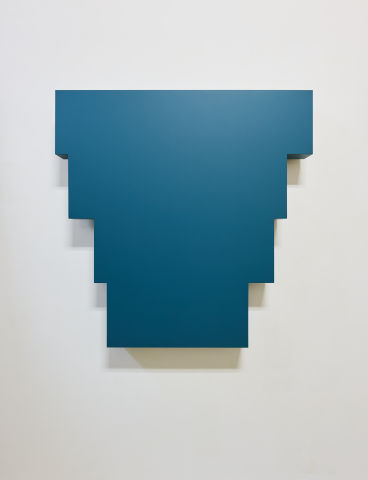
François Perrodin, 97.5 2026 Wood, acryl paint 120x120x9cm
From a topological perspective, even as forms stretch, proportions shift, and processes of expansion and deformation are repeated. The topological identity of the structure remains intact. In the series “95/96,” the proportional relationship of the outer lateral lines is rearranged in reverse order; in “97/98,” vertical proportions are progressively reduced, resulting in greater density. Surface differences are evident, yet structure and transformation do not conflict; they coexist within the same generative logic.
This body of work produces stratified discontinuities only when the conditions of overlap, proportion, and accumulation reach a specific threshold. Latent rules must accumulate sufficiently before a subsequent phase can emerge. In this way, the work embodies a temporality in which slowness and acceleration, continuity and rupture, intersect. The superimposition of thin rectangles functions as a geometric ensemble that manifests a state already infused with motion.
Ultimately, François Perrodin’s practice reinterprets the tradition of Art Construit from a contemporary perspective, effectively expanding its theoretical horizons. While concrete art relied on fixed orders and mathematical proportions, he activates a transposed order, one that reorganizes itself according to changes in position and condition, preserving the generative principle while embedding algorithms intrinsically within the objects, rendering them tangible and perceptible.
The artist further recontextualizes the logic of Minimalism and Conceptual Art. Whereas Donald Judd emphasized the presence and autonomy of material, and Sol LeWitt foregrounded the primacy of conceptual rules, François Perrodin proposes a structural “third position” in which material and rules operate in mutual generativity. Here, form neither precedes the object nor reduces it to a set of rules; rather, the two intersect and continuously transform each another. This approach transcends fixed geometries, situating form within the interplay of matter and data, and opening a field of thought in which perceptual and cognitive exploration becomes an experiential journey for the viewer, attuned to the unfolding dynamics of transformation. Text & translation: NOH Kyung-hwa
Song Art Gallery
Acrovista Arcade, 188, Seochojungang-ro, Seocho-gu, Seoul, 06600, Republic of Korea
82 2 3482 7096
[GALLERIES] SONG ART GALLERY
- Dates
- 2026. 3. 18 – 4. 20
MORE LIKE THIS