More Familiar and Much Stranger
2026. 12. 4. - 2027. 1. 16. | [GALLERIES] Gallery JJ
Susa Reinhardt
𝘔𝘰𝘳𝘦 𝘍𝘢𝘮𝘪𝘭𝘪𝘢𝘳 𝘢𝘯𝘥 𝘔𝘶𝘤𝘩 𝘚𝘵𝘳𝘢𝘯𝘨𝘦𝘳
Gallery JJ
2026. 12. 4. – 2027. 1. 16.
*Opening Reception: Dec 4, 2026 (Fri) 5-7PM
Gallery JJ is pleased to present 𝘚𝘶𝘴𝘢 𝘙𝘦𝘪𝘯𝘩𝘢𝘳𝘥𝘵: 𝘔𝘰𝘳𝘦 𝘍𝘢𝘮𝘪𝘭𝘪𝘢𝘳 𝘢𝘯𝘥 𝘔𝘶𝘤𝘩 𝘚𝘵𝘳𝘢𝘯𝘨𝘦𝘳, the first solo exhibition in Korea by Susa Reinhardt, a German artist based in Stuttgart and Berlin. Reinhardt is known for serene, idyllic landscapes and has built a distinct painterly language around atmospheres that are uplifting and calm. Her paintings explore sensation and visual perception within pictorial space, while opening onto broader questions about the relationship between humans and nature and, by extension, to the world.
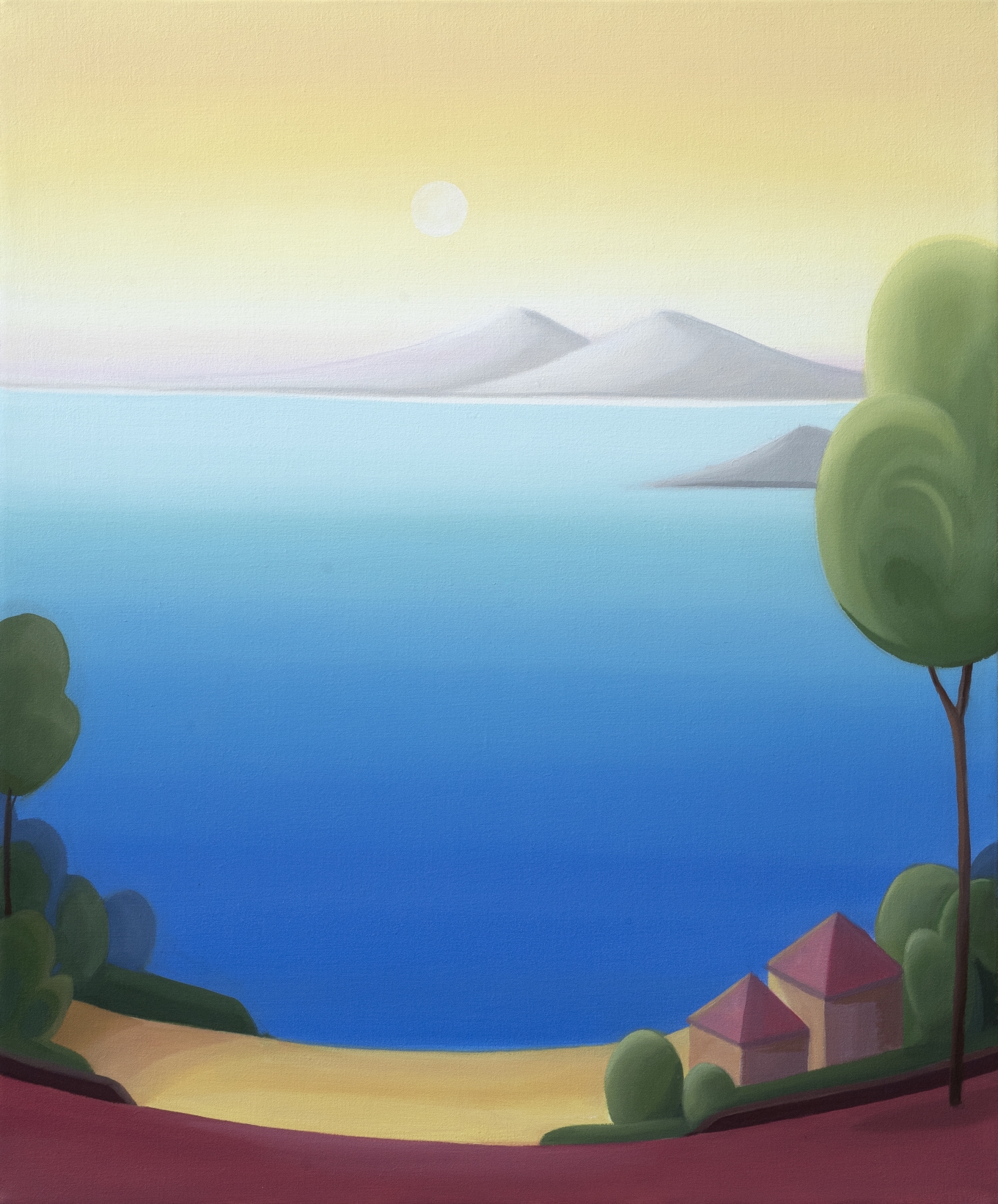 Blue Haven, 2026. Oil on canvas, 44 x 36 cm.
The exhibition brings together some twenty signature landscapes, mostly recent, with drawings and paper collages. Reinhardt invites us to look again at landscape painting, a genre we assume we know well. The dreamlike scenes of nature she creates are more familiar than we expect, and much stranger.
In a digital environment where artificial intelligence floods us with images, landscape painting may seem a classical genre grown stale and clichéd. Yet even when abstraction and Pop art dominated late twentieth-century painting, and painting itself was crowded out by Conceptual art, performance, and installation, and other practices, landscape persisted alongside them. It later seeped into abstraction and became one strand of Land art. In Landscape Painting Now (2019), the critic Barry Schwabsky writes that landscape is, if anything, thriving today, reinvented by each artist through a personal idea of the genre. Painters no longer shy away from, and even enjoy, the fact that a picture may be merely “pretty pictorial.” Reinhardt’s landscapes show yet another side of contemporary landscape painting.
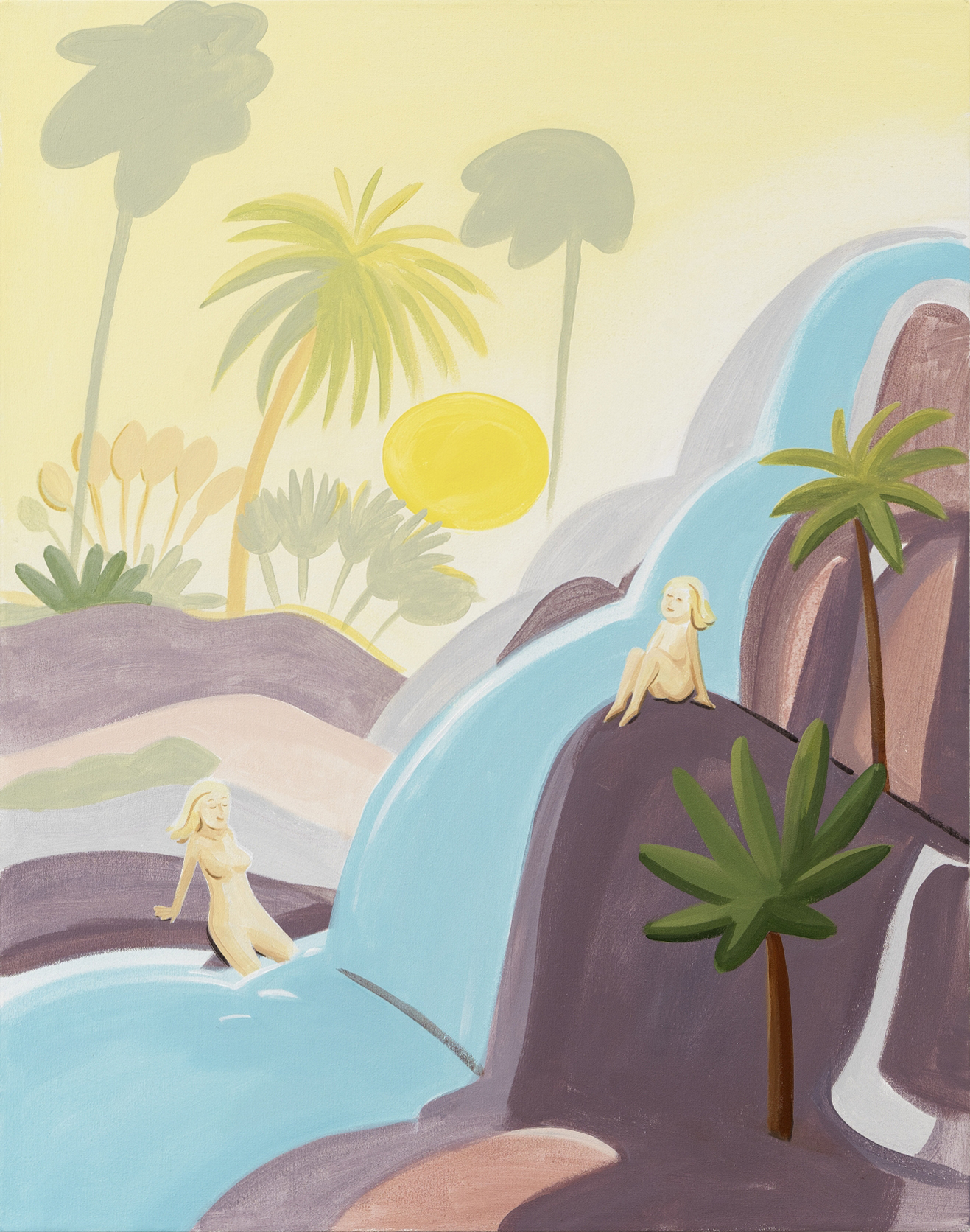 Nympheas, 2026. Acrylic on canvas, 70 x 55 cm.
Reinhardt approaches landscape as a “cultural construct,” a visual code and frame formed by socialization and by cultural and historical context, a composite of many symbols. The lakes, gardens, trees, and forests that recur in her paintings reveal how our perception of nature is built through identification and classification, and they call our relationship to it into question.
In this light, Reinhardt offers an alternative to the Romantic, mystical, and monumental character of traditional landscape painting. She draws on that tradition but remakes the image of nature through new concepts and methods, favoring spaces of ease, openness, and well-being, and absorbing popular visual culture, from animation and comics to Pop art. Her manicured scenes look, on closer inspection, less like real places than pastoral ideals, and behind their calm we glimpse the inner desires projected onto nature and the cultural signs of an era.
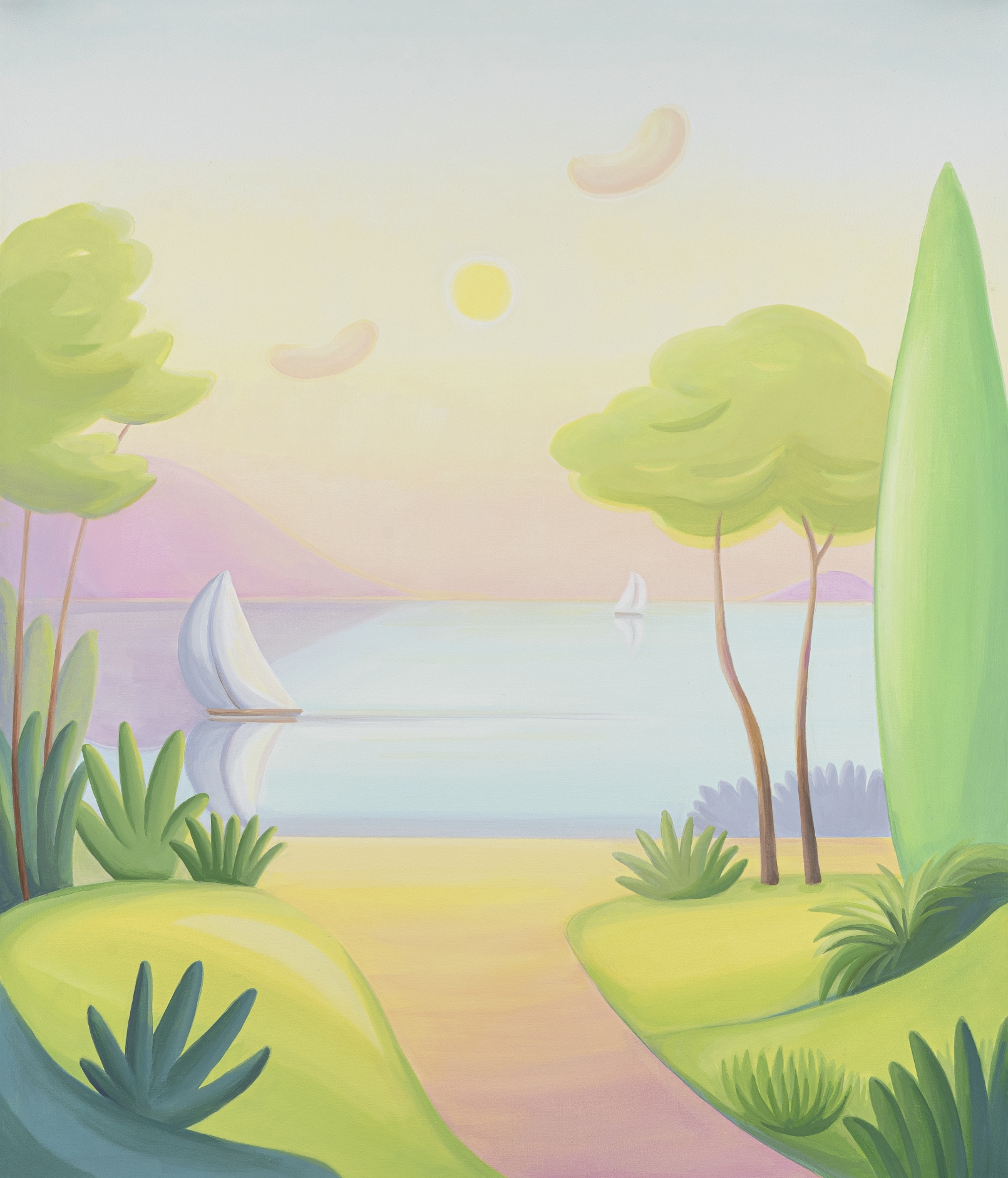 Breeze on the Water, 2026. Acrylic on canvas, 70 x 82 cm.
Reinhardt studied stage design at the State Academy of Fine Arts Stuttgart, then completed her Meisterschülerin studies in painting under the conceptual artist Joseph Kosuth. In the early 1990s, while still a student, she joined the collective 3K-NH experimenting with a conceptual, public-facing “new-pop” painting alongside Michel Majerus and others. It was a collaborative effort that actively appropriated the visual signs of contemporary capitalism, including popular culture, advertising logos, video games, and pop music, and reinterpreting them through a 1990s sensibility distinct from 1960s pop art. Since the 2000s she has developed her own landscape vocabulary, while the pop painting of those years continues in a separate series drawn from everyday moments. That grounding in Conceptual art and Pop seems to have shaped her thinking about how art connects to reality. Her works are held in major institutions, including the Kunstmuseum Stuttgart and Mudam Luxembourg.
Stylized forms and soft color give her paintings a distinctive aesthetic, a compelling fusion of long experience in painting, stage design, Conceptual art, animation, and Pop. The works are Post-Pop in their awareness of existing images and popular forms, which they reduce to schemas. Conceptual rigor and a longing for the ideal coexist without canceling each other out.
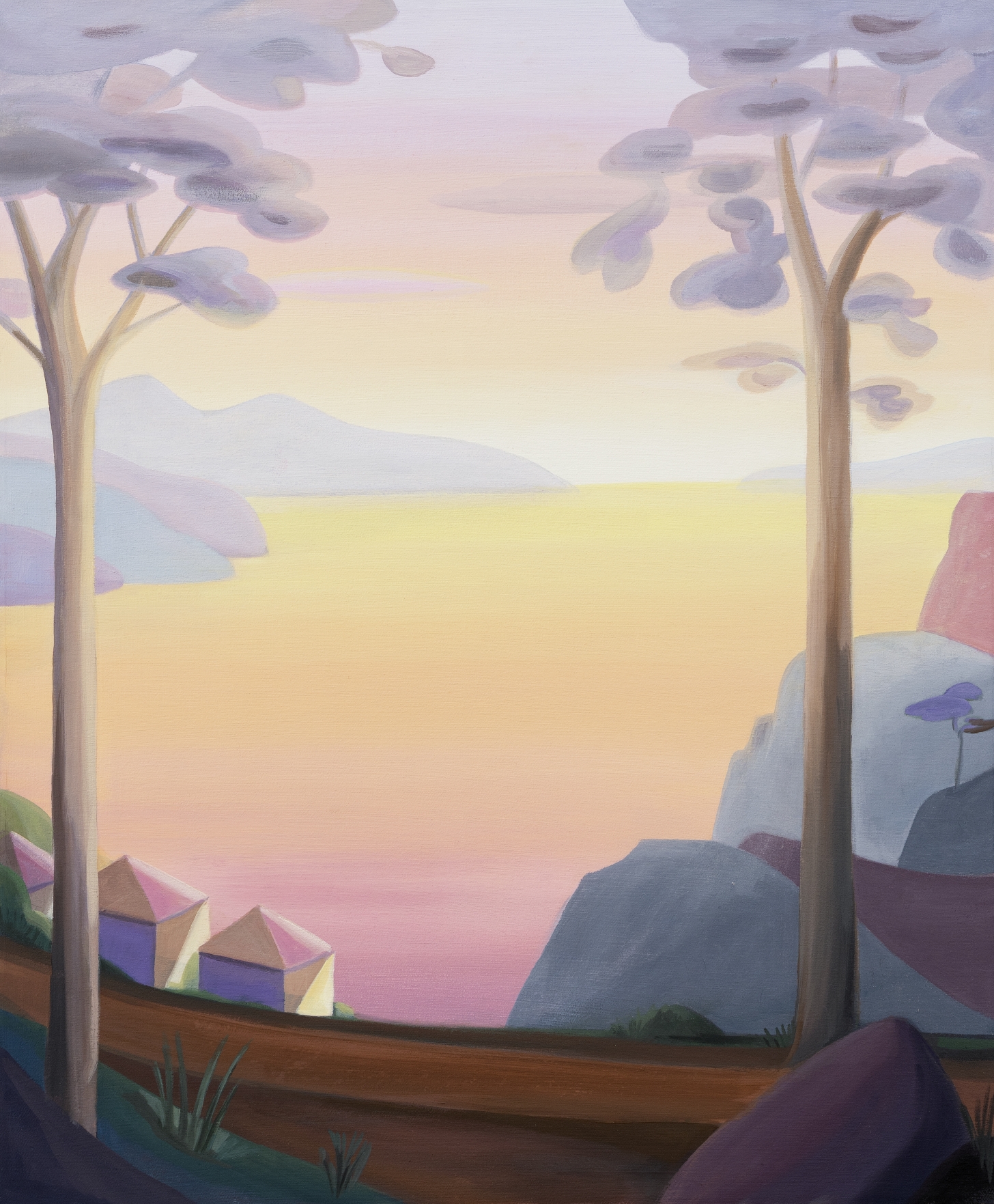 Pink Mirage, 2024. Oil on canvas, 44 x 36 cm.
I
Smooth surfaces of thinly layered oil paint, consistently warm pastel tones, and simple compositions let viewers step out of reality into a peaceful, dreamlike mood. Their empty spaces, storybook-like yet immaculately ordered, hold a subtle stillness, and the scenes feel subtly surreal. The places seem lyrical yet artificial, like imagined or unfamiliar sites, an impression echoed in titles such as Mirage, Haven, and Dream. Reinhardt’s landscapes are not realistic or naturalistic; by her account, they draw on frequent trips to Italy but depict no particular place, only spaces distilled from memory, observation, and imagination. She also makes many oil-pastel sketches while traveling. The atmosphere and natural surroundings of Italy provide a starting point for her unhurried landscape painting and leisurely encounter with nature.
To see nature is to recast its disordered data into familiar, orderly forms. Kant held that we see objects not as they are in themselves but through the cognitive framework our own minds impose. Through formal reduction and stylized, condensed visual language, Reinhardt underscores that visual perception is a synthesis of regular acts of identification and classification.
Her process is one of reduction and refinement. To simplify the composition, she omits detail and turns each element, whether tree, house, or lake, into a single field of color. The collages in this exhibition are central to that process. Before painting in oil, she cuts and pastes sheets of painted paper, choosing each hue precisely until the color fields balance. Every motif thus settles into a clear, pure form, with no trace of revision. In Blue Haven (2026) and Dreaming of the Sea (2026), the clear sky, the blue lake at center, and above all the trees lining either side lead the eye from nature to manmade elements such as houses and roads. Pointed red roofs and cypress-lined roads are simple, instantly familiar regional forms. Like the trees, clouds, and hills, they are not realistic depictions but signs, pared down for recognition at a glance.
Our understanding of nature is filtered in much the same way. Nature has long been seen as a place of rest, a consoling refuge that embraces us. Ancient landscape murals served leisure and recreation, and Renaissance landscape painting was at times thought to substitute for real scenery, offering pleasure and psychological comfort. The picturesque, nature seen “like a picture,” began with Claude Lorrain’s seventeenth-century landscapes and took hold as a taste in the eighteenth; in the industrial age, nature was idealized as an escape from the grind of city life. In the West, landscape long played a supporting role, but in East Asia, where it was the premier genre of painting, the idea of woyou (臥遊), traveling with the eyes while reclining at leisure, sought to convey the delight of a spirit roaming free and a realm of absolute freedom.
The more idealized a place, the further out of reach it lies, and that distance makes the picture more beautiful. Reinhardt builds such images from charming colors, an animation-like style, soft contours, and the occasional animal or figure. Her paintings hold a utopian element, the archetype of Arcadia: a place of healing lodged in the human unconscious, an unreachable ideal onto which we project inner longing. The pastoral surface of her work reflects our wish to imagine nature as a beautiful, comforting place of rest.
In this way, Reinhardt’s landscapes continue the picturesque tradition. At the same time, she scatters and isolates elements, and her backlit, contrasting forms and flattened space create a faint unease that disrupts the pastoral illusion. Ideal yet artificially strange, the scenes remind us that this is no real place but a world we cannot reach. The paintings quietly reflect on the traditional image of nature as redemptive and pastoral.
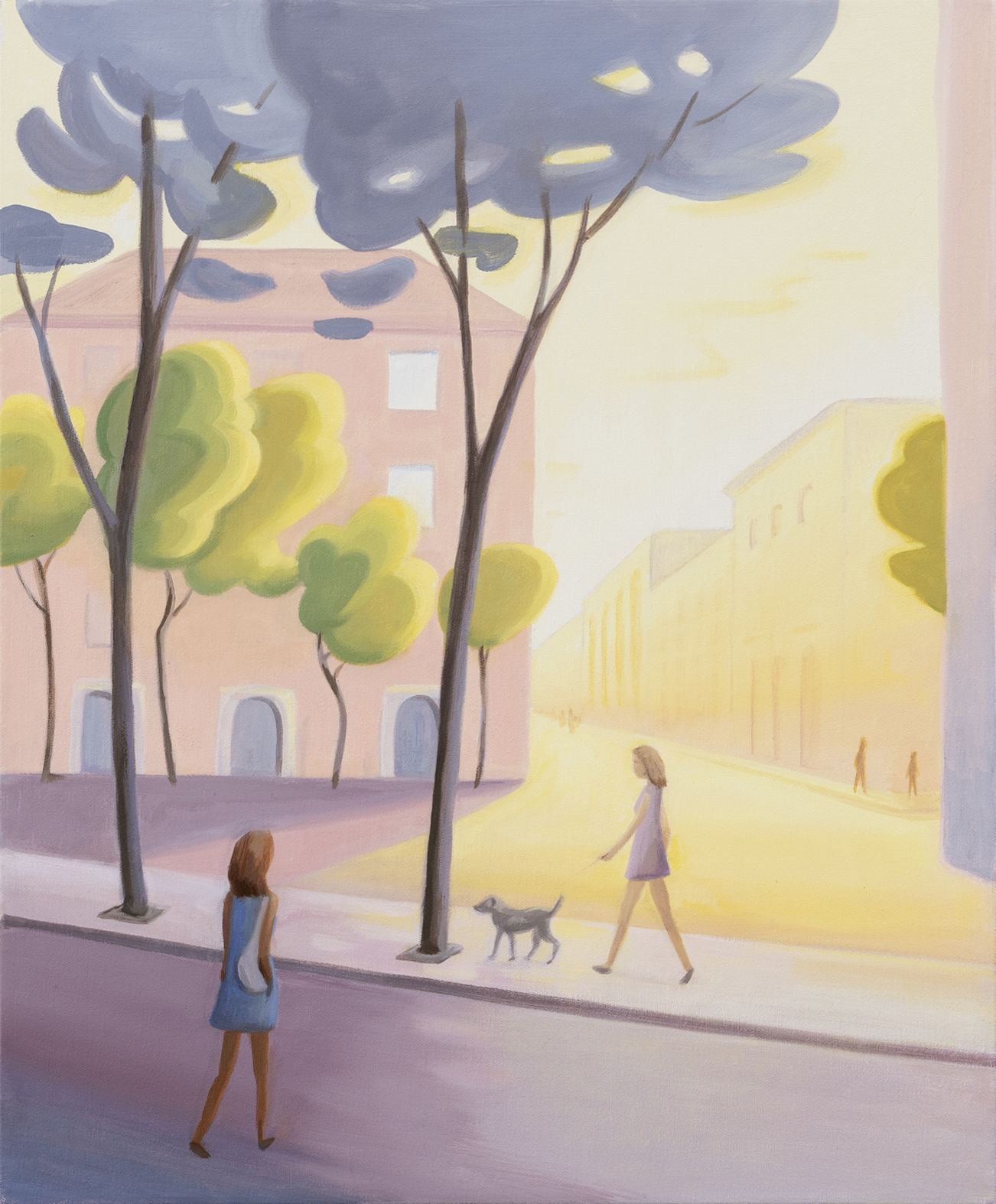 Eventide, 2025. Oil on canvas, 44 x 36 cm.
II
Her compositions appropriate historical landscape painting and the background design of classic animated films. Trees framing the scene on either side and a path leading inward form a conventional landscape composition that also recalls a stage. The landscape is at once protagonist and backdrop, nature’s scenery is the subject, while a view emptied of people becomes a stage for each viewer’s inner stories. In the West, landscape remained a background for centuries. Only around the seventeenth century was it recognized as an independent genre, and even then as a setting for history painting or a lesser genre, until Romanticism made it a major subject and Impressionism brought it to its peak. In Reinhardt’s paintings, landscape holds both positions, subject and backdrop. Schwabsky criticizes the view of nature as a stage for human action, but by openly building her landscapes as stages, Reinhardt puts that very way of looking on display. Her tutor, Kosuth, wrote in a 1996 letter of recommendation that her work turns discomfort into comfort, a remark that still holds today.
In recent works such as Eventide (2025), her sparsely populated landscapes now hold people resting and meeting in well-tended gardens and squares. Her pop-style paintings, brief illustration-like scenes that appear as snapshots, create a bright, distinctive atmosphere and share the pleasures of daily life. Reinhardt hopes her paintings can relax the viewer’s perception and hold easily overlooked ordinary moments on the picture plane.
As conditions of life change rapidly, the idea of landscape seems ever more necessary and important. With urbanization taking away what people once had and the need for contact with nature growing urgent, approaches to landscape have multiplied, approaches to landscape have multiplied, from Anselm Kiefer’s Romantic landscapes and David Hockney’s post-Pop scenes to the abstract terrains of Shara Hughes and Julie Mehretu. In the twenty-first century, the climate crisis may have given the idea of landscape even greater weight. In the modern view, nature was landscape as an object we look at. Humans were spectators outside the frame, and nature was a passive backdrop to our drama. The philosopher Bruno Latour rejected this dualism of subject and object, culture and nature, which views the nonhuman world purely from a human standpoint. Contemporary art, too, engages actively with nature, or sees it as the environment to which we belong, exploring the planet’s material conditions rather than idealizing it as infinite.
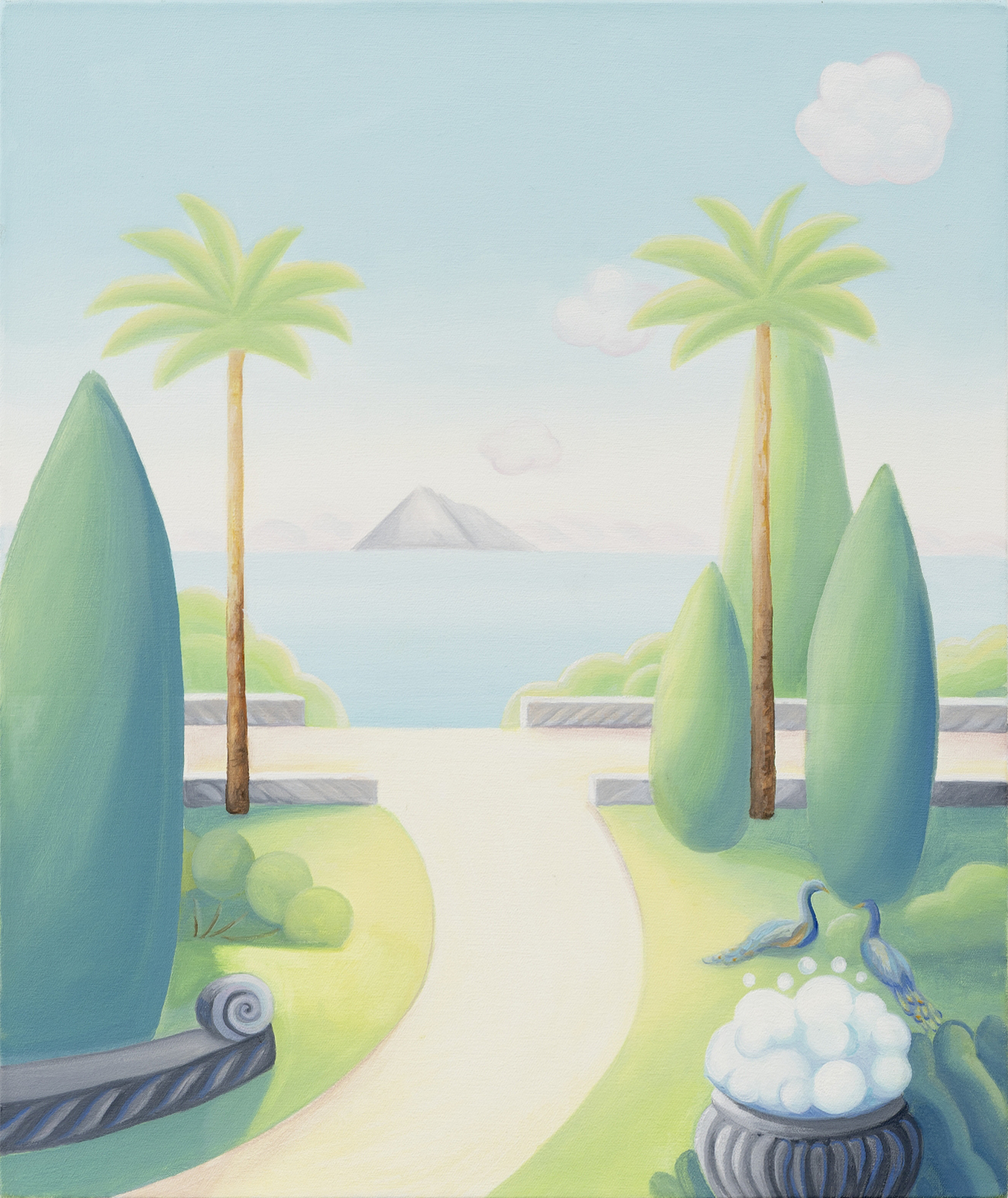 Gateway to the Deep Part II, 2021. Oil on canvas, 44 x 36 cm.
Instead of intervening in nature, Reinhardt pulls that very gaze, once held outside the frame, into the picture itself—slow, quiet images. Her landscapes may still look Romantic, yet they disrupt that impression by revealing the image as divided, bounded, and framed. Familiar as scenes from postcards, animation, and old landscape paintings, they grow stranger the longer we look, and in that strangeness, we meet our own way of seeing nature. Even so, we find ourselves wanting to linger, drawn by an empathy and attachment rooted in the desire to reclaim the balanced rhythms of life lost to the relentless pace of technological civilization.
Juyeon Kang, Gallery JJ Director
Images: © Susa Reinhardt. Courtesy of the artist and Gallery JJ.
Text: Courtesy of Gallery JJ.
Gallery JJ
63 Apgujeong-ro 30-gil, Gangnam-gu, Seoul
+82-2-322-3979
WEB INSTAGRAM FACEBOOK YOUTUBE ARTSY
[GALLERIES] Gallery JJ
- Dates
- 2026. 12. 4. - 2027. 1. 16.
MORE LIKE THIS