


Superposition: Floating Landscape
2026. 10. 07 - 11. 03 | [GALLERIES] SUN GALLERY
Byoungyun Woo
Superposition: Floating Landscape
SUN GALLERY
2026. 10. 07 – 11. 03
SUN Gallery presents Superposition: Floating Landscape, a solo exhibition by ByoungYun Woo (b. 1988), from October 7 to November 3, 2026. Following his participation in the gallery’s 2024 group exhibition Nature-Regressive Desire, this marks Woo’s first solo exhibition at SUN Gallery. Bringing together 32 paintings, with a focus on his Superposition series and the new Floating Landscape series that builds upon it, the exhibition traces how his exploration of material surfaces has developed into an investigation of landscape forms and pictorial space.
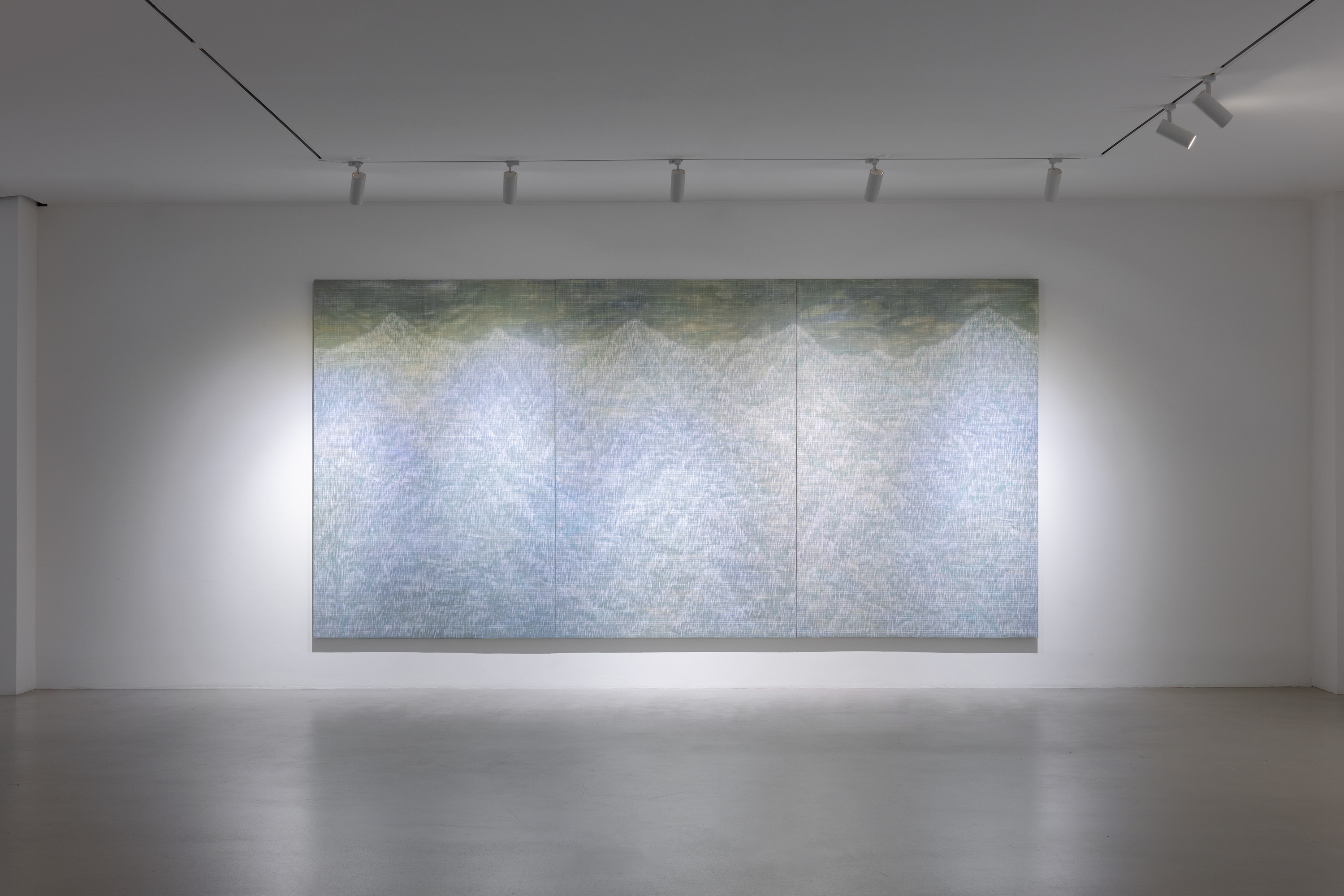 Installation view of 《Superposition: Floating Landscape》, 2026.
Woo seeks to approach nature as a world that continues independently of the human gaze, rather than as a backdrop reflecting his own emotions or memories. The artist, too, is a being temporarily held within this world; nature is a field in which diverse beings and movements connect and continue through their relationships. This perspective leads him beyond the depiction of forms resembling nature to an exploration of how landscapes emerge through materials and actions.
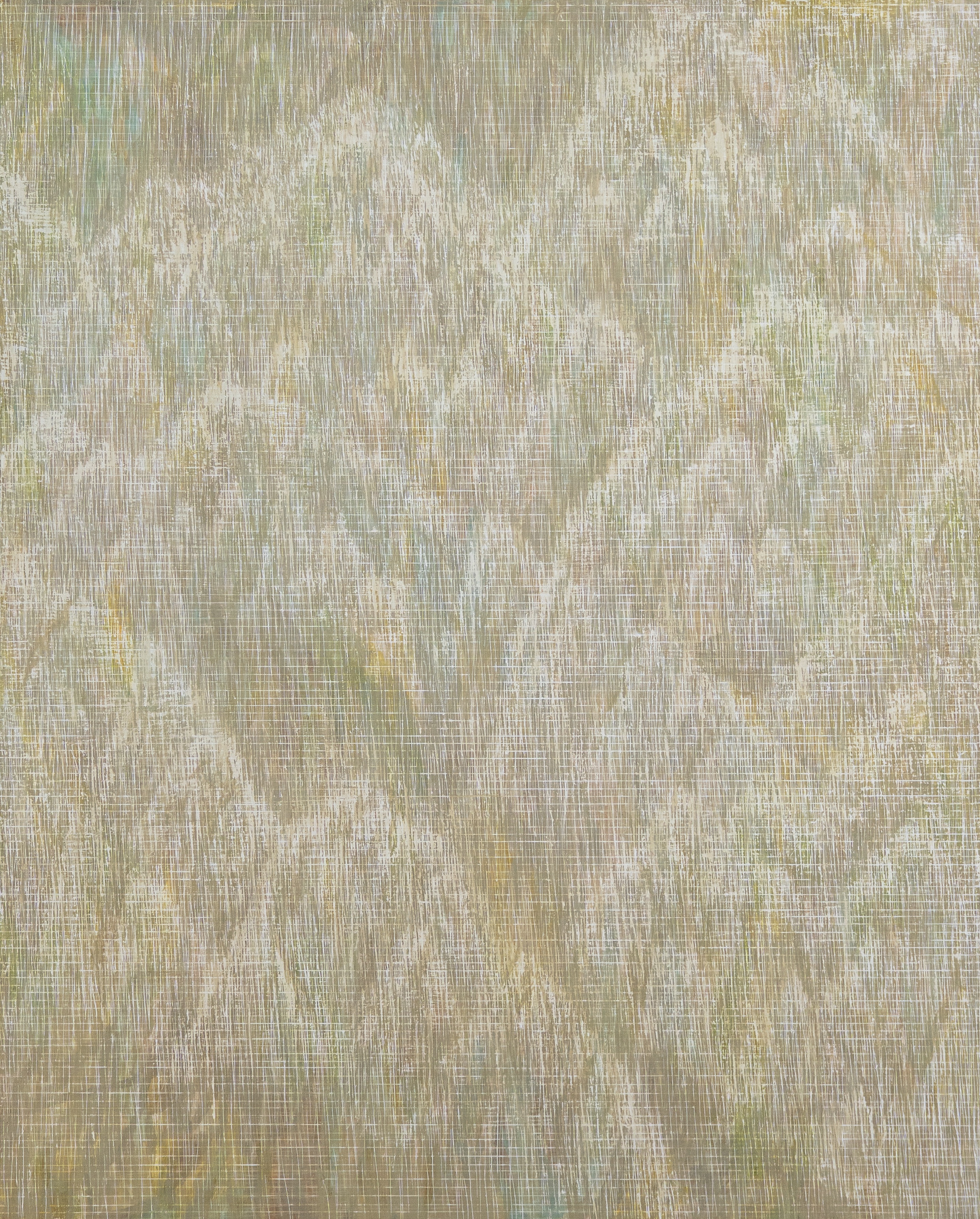 들떠 있는 풍경 (Floating Landscape) 26-08-322, 2026.
Mixed media on wood panel, 162 x 130.3 cm
In the Superposition series, Woo applies plaster to wood panels, creating ridges and furrows before adding color and scraping back the painted surface. The act of building up plaster intersects with that of removing color, while the lines formed by the uneven ground cross those made by scraping. Through this process, lines shift between abstract textures, waves, and, at times, mountain-like forms, producing a pictorial surface where material traces and images overlap.
In the new Floating Landscape series, Woo no longer creates ridges and furrows when applying the plaster, as these pre-existing textures can interfere with the lines that shape the mass of a mountain and its surrounding space. Instead, he establishes a field of color on a flat plaster ground, then repeatedly scrapes the painted surface in one direction to reveal the white plaster beneath. As lines of varying lengths and densities accumulate, the contours, tonal values, and volume of a mountain emerge. The landscape is an image that takes shape where color has been removed, rather than one painted by adding color. This shift expands the role of the line. Whereas lines in earlier works revealed material textures or abstract forms, they now construct landscape forms and space more directly. The mountain remains recognizable, while the lines and scraped surface that constitute it are also visible. The viewer’s gaze moves between the landscape image and the material from which it is made.
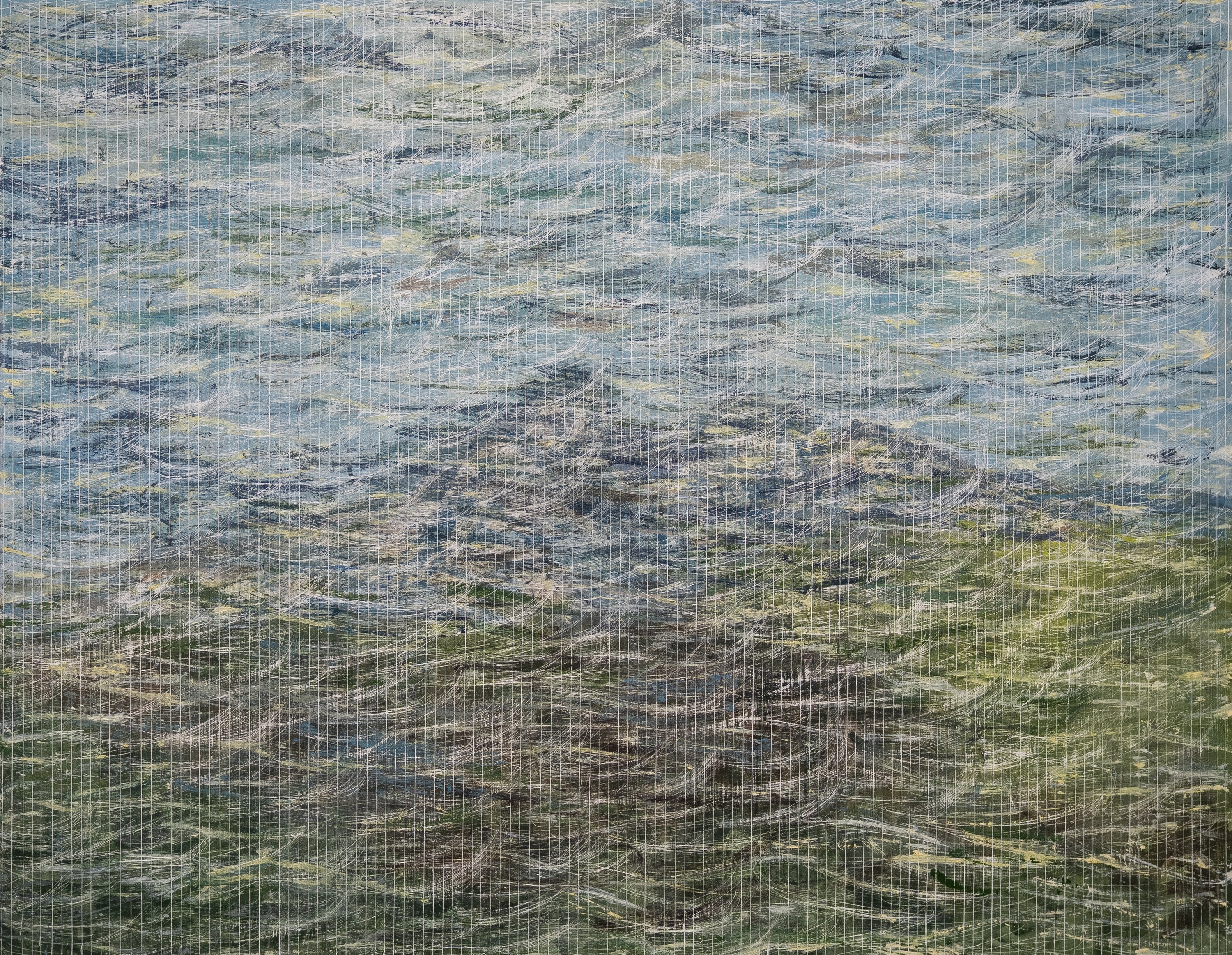 율려 律呂 (Yoolryoe) 25-08-13, 2025.
Plaster and gouache on wood panel, 91 x 116.7 cm
Woo then draws evenly spaced horizontal or vertical lines over these organically varying lines. While the changing lines create the mass of a mountain and pictorial depth, the regular geometric lines cut across that space, bringing the flatness of the picture plane back into view. Natural flow and imposed order, image and surface, intersect within a single work without erasing one another.
The word “floating” in the exhibition title does not imply an absence of relationships or simply an image suspended in midair. It describes a condition in which the relationships between self and nature, abstraction and landscape, flatness and depth remain unfixed. The mountain appears on the surface but never fully settles into a stable space; it moves between the lines and surface that constitute it. Woo calls this a “floating landscape,” where different states briefly meet and remain together.Here, nature cannot be explained solely through the artist’s emotions or memories. The landscape emerges from the relationships among plaster, color, and the repeated movements of his hand. His approach to nature is connected to the way he handles materials, while the lines and surfaces that construct the landscape remain integral to the work alongside the image itself.
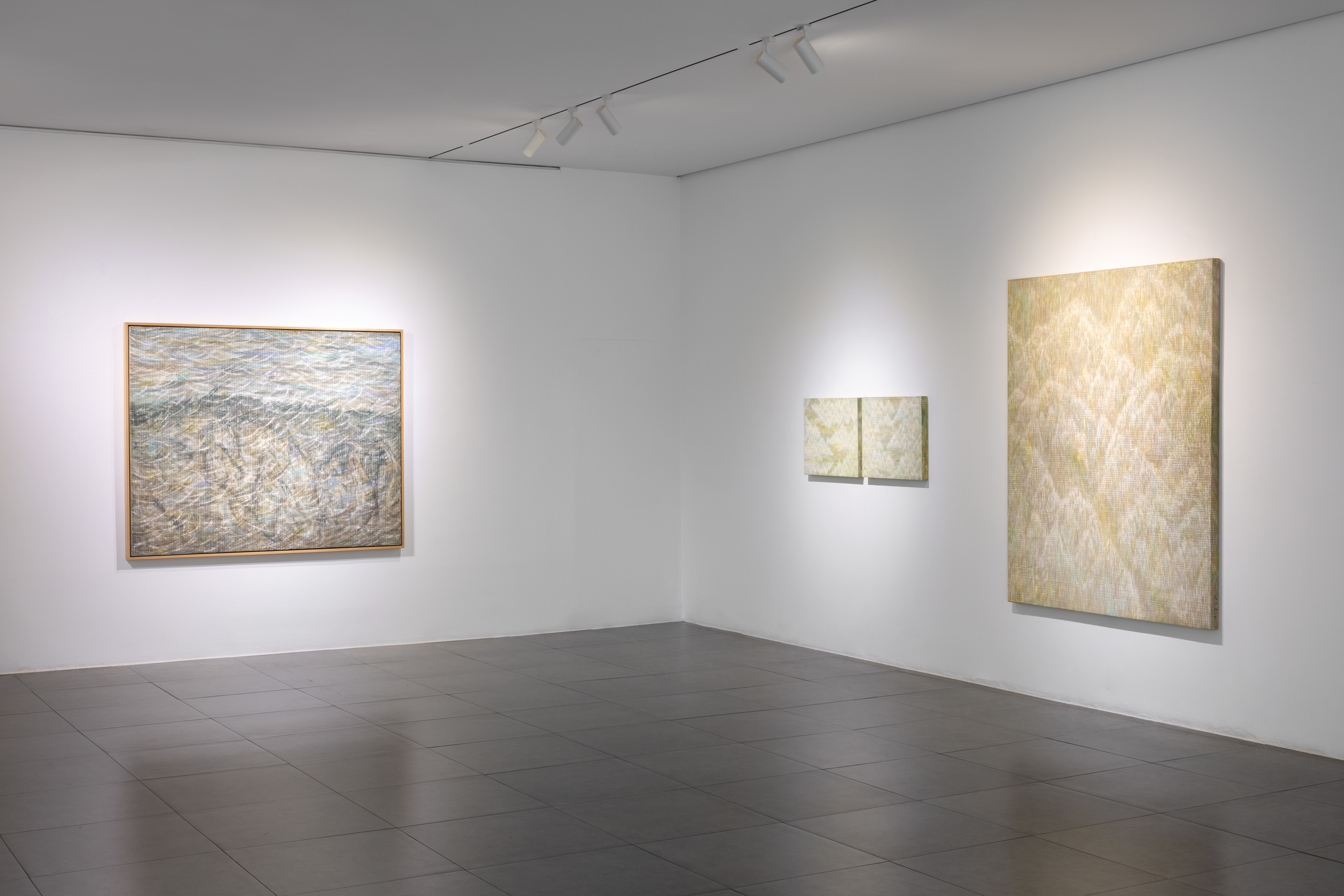 Installation view of 《Superposition: Floating Landscape》, 2026.
Superposition: Floating Landscape shows how the investigation developed through the acts of building up and removing material in Superposition extends into landscape forms and pictorial space. Viewers follow the mountain’s form before turning their attention to the lines and plaster surface that compose it. Through this movement of the gaze, the exhibition invites a renewed perception of the relationships between nature and humans, abstraction and landscape, flatness and depth.
Images: Courtesy of the artist and SUN GALLERY.
Text: Courtesy of SUN GALLERY.
SUN GALLERY
8, Insa-dong 5-gil, Jongno-gu, Seoul, Korea
+82-2-734-0458
WEB INSTAGRAM ARTSY
[GALLERIES] SUN GALLERY
- Dates
- 2026. 10. 07 - 11. 03
MORE LIKE THIS


